


A commercial floor care specialist treats each floor type as its own job, with its own written method, schedule and maintenance plan. General janitorial service keeps a building tidy.
It does not usually strip, refinish, polish or restore a floor. Before you sign with any contractor, check four things: a written scope for every floor type, a test area on your floor, a plan for work outside your business hours, and a maintenance plan for after the first job.
This guide shows how a facility, property or operations manager can compare commercial floor cleaning providers for one building or many. Use it as a checklist you can verify, not a list of names.
What commercial floor care covers
Commercial floor care is the full set of work that keeps a floor safe, clean and in service. It includes routine cleaning, deep cleaning, refinishing, restoration and a maintenance plan.
The right method depends on the floor. A method that suits one surface can damage another.
Resilient tile and vinyl
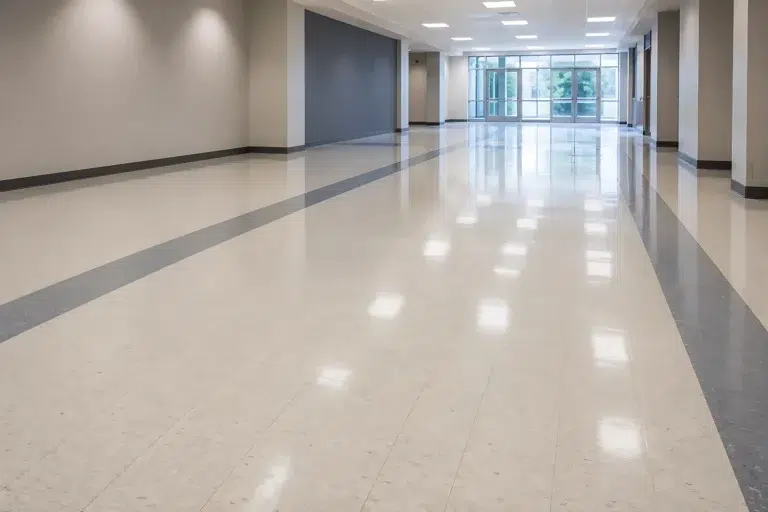
Vinyl composition tile and similar floors usually need regular cleaning and a periodic finish cycle. When the finish wears through, the floor needs a full commercial VCT strip and wax rather than another coat on top of old buildup.
Concrete
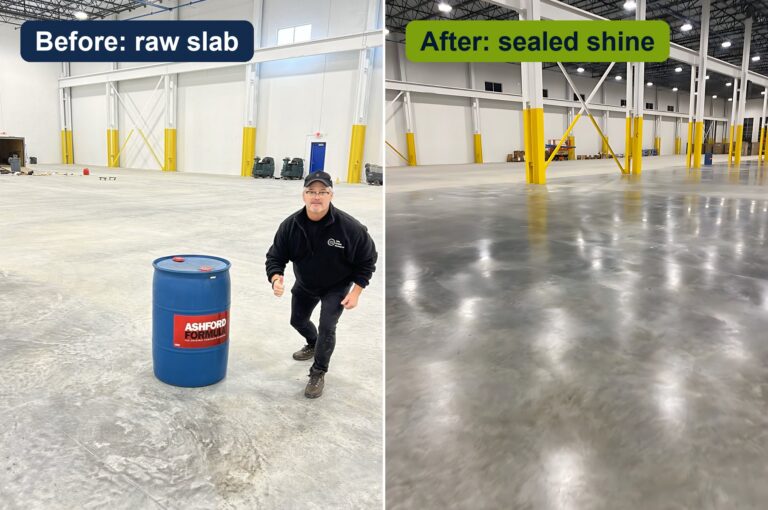
Concrete floors in warehouses, plants and retail spaces collect oil, tire marks and dust. Cleaning and sealing protect the surface, and commercial concrete polishing gives a harder, easier floor to maintain. Commercial concrete floor cleaning starts with a plan for the type of soil and the finish already on the slab.
Hard surfaces, carpet and specialty floors
Ceramic, porcelain, natural stone, terrazzo, sealed wood and carpet each have their own rules for chemistry, tools and drying. A specialist names those rules in the scope. For a wider view of the work, read about types of commercial floor services.
Signs you need a specialist, not general janitorial service
General cleaning is enough when floors are in good shape and you only need upkeep. You need a floor specialist when the problem is the floor itself.
- The finish looks dull or yellow even after cleaning.
- Black marks, scuffs or buildup return soon after each clean.
- Grout lines, seams or edges stay dark.
- Concrete shows stains, dusting or worn patches.
- Floors feel slick in some areas and sticky in others.
- Your cleaning crew keeps adding coats, mopping harder or switching products without fixing the look.
Any one of these points to a floor care problem. Repeating the same cleaning more often will not solve it and can make it worse.
How to compare commercial floor care contractors
Use the same checklist for every contractor. If a provider cannot answer a point in writing, treat it as missing. The list below reflects what a manager can verify before signing, and it works whether you buy commercial floor cleaning services for one building or for a portfolio.
1. A written scope for each floor type
The scope should list every floor type, the method for each, the products and tools in plain terms, and what is included or excluded. A single line such as “clean all floors” is not a scope.
2. A test area
Ask the contractor to treat a small area of your own floor first. You then see the result on your surface, under your lighting, before you commit the whole building.
3. A schedule and after-hours plan
The contractor should show when crews arrive, how they protect open areas and how they hand the space back. Ask what happens if the job runs late or the weather delays a crew.
4. A maintenance plan after the first job
A strong first result fades without upkeep. The contractor should explain what your own team does, what the specialist does and how often. Our guide on what to look for in a floor maintenance program goes deeper on this point.
5. A commercial-only focus
A contractor that works only in commercial buildings plans around tenants, customers, deliveries and shift changes. Residential habits do not carry over to a store, school or plant.
6. Coverage for more than one site
If you run several locations, ask whether one contractor can serve all of them with one scope and one contact. Splitting sites across many small vendors makes standards drift.
Questions to ask before you sign
These questions separate a floor specialist from a general cleaner. Ask them in writing and keep the answers with the contract.
- Which floor types in my building do you work on most often?
- What is your method for each of my floor types?
- Can you treat a test area before I approve the full job?
- What is your plan for work outside my business hours?
- How do you protect furniture, equipment, walls and open areas?
- Who is my single contact, and how fast do you respond to a problem?
- What does the maintenance plan look like after the first job?
- How do you handle a floor that does not respond as expected?
- How do you report on completed work at each location?
Listen for specific answers. Vague answers usually mean the scope is vague too.
What a good quote includes
A quote is easier to compare when it is built the same way each time. A useful quote for commercial floor maintenance lists the following, with no gaps.
- Each floor type and each area, named separately.
- The method and finish for each area.
- The work dates, hours and the plan for areas that stay open.
- What the owner or tenant must prepare, such as clearing furniture.
- The follow-up maintenance plan and who performs each task.
- What is not included, so extras do not appear later.
Compare scopes first and the totals second. A low total with a thin scope often leaves you paying for the missing work later.
Running one floor care program across many locations
Multi-site managers need one standard, not a different job at each address. The aim is that a visitor sees the same floor condition in every building, while each site still gets the method its floors need.
Start with an inventory of floor types at every location, then set one scope format and one reporting format. Ask whether the contractor can serve each region directly. Our page on commercial floor care by state shows how coverage works across the country.
Keep one point of contact for the whole program and review results on a fixed rhythm. When one site changes use, floor or traffic, update the scope for that site and leave the rest alone.
Planning the work in your building
To get a useful quote, send the floor types, the approximate area for each, photos of the current condition and your working hours. Note any area that must stay open and any area with special use, such as a kitchen, loading dock or patient space.
TCS Floors schedules work at night and on weekends, so your business stays open during the day. We build customized maintenance programs around your floors, your traffic and your calendar, so the first result lasts.
TCS Floors is commercial only, works nationwide and has 33+ years in the trade. Send us your floor details and we will return a written scope for your building or for every location in your program.
Frequently asked questions
What is the difference between commercial floor care and general janitorial service?
Janitorial service keeps a building tidy day to day. Commercial floor care is a separate trade.
It covers deep cleaning, stripping and refinishing, restoration, polishing and the maintenance plan that protects the floor between those jobs. Each floor type needs its own method and its own written scope.
How do I compare commercial floor cleaning companies?
Ask each one for a written scope per floor type, a test area on your own floor, a schedule that fits your working hours, and a maintenance plan for after the first job. Check that the contractor focuses on commercial buildings and can cover every location you run. Compare the scopes line by line, not only the totals.
What should a commercial floor maintenance program include?
A good program names each floor type, the task for each area, how often the task happens, who does it and when. It also says how problems are reported and how the program changes when traffic, use or finishes change. The plan should be in writing and match your building, not a generic template.
Can one contractor handle floor care at many locations?
Yes, if the contractor works nationwide and runs every site from one scope, one schedule format and one point of contact. Ask how they report on each site and how they handle a location that needs a different floor type or a different working window.
Do commercial floor care services work nights and weekends?
They should. Most commercial buildings cannot close during the day, so ask for a written after-hours plan that shows when crews arrive, which areas are done first and when each area reopens to traffic. TCS Floors schedules work at night and on weekends.
What should I send to get a commercial floor care quote?
Send the floor types, the approximate size of each area, photos of the current condition, your working hours and any areas that must stay open. For several sites, send the same details for each location so the quotes can be compared on equal terms.