
Types of Commercial Concrete Floor Coatings and How to Choose the Right One
Last Updated: June 2026
Commercial concrete floors face constant abuse from forklifts, heavy equipment, chemicals, moisture, foot traffic, and daily operations. Choosing the right floor coating protects your investment, improves workplace safety, reduces maintenance, and extends the life of your concrete.
This guide explains the most common types of commercial concrete floor coatings, where each performs best, and how to select the right system for your facility.
Key Takeaways
- Epoxy remains one of the most popular commercial floor coating systems.
- Polyurethane offers excellent chemical and abrasion resistance.
- Polyaspartic coatings cure quickly with minimal downtime.
- Urethane cement performs well in food processing and heavy industrial facilities.
- MMA coatings allow installation in cold environments and rapid return to service.
- The best coating depends on traffic levels, chemicals, moisture, and facility requirements.
What Are Commercial Concrete Floor Coatings?
Commercial concrete floor coatings are protective systems applied over concrete to improve durability, chemical resistance, appearance, safety, and ease of maintenance.
Unlike residential coatings, commercial systems are designed for demanding environments including:
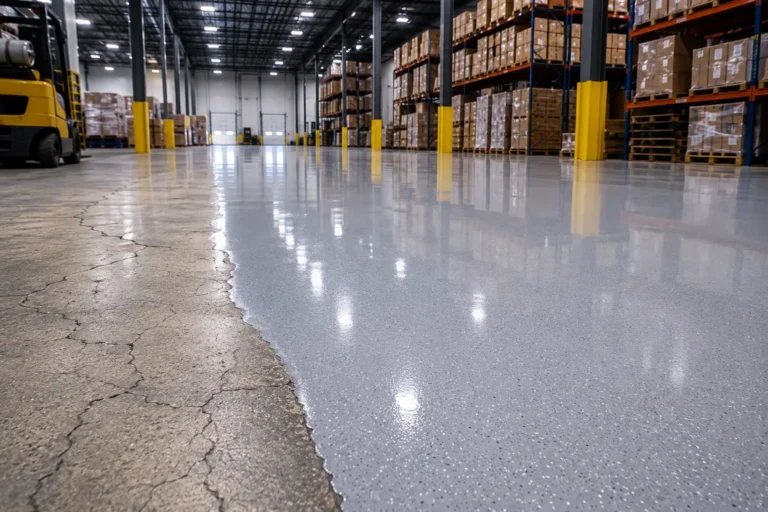
- Warehouses
- Manufacturing plants
- Distribution centers
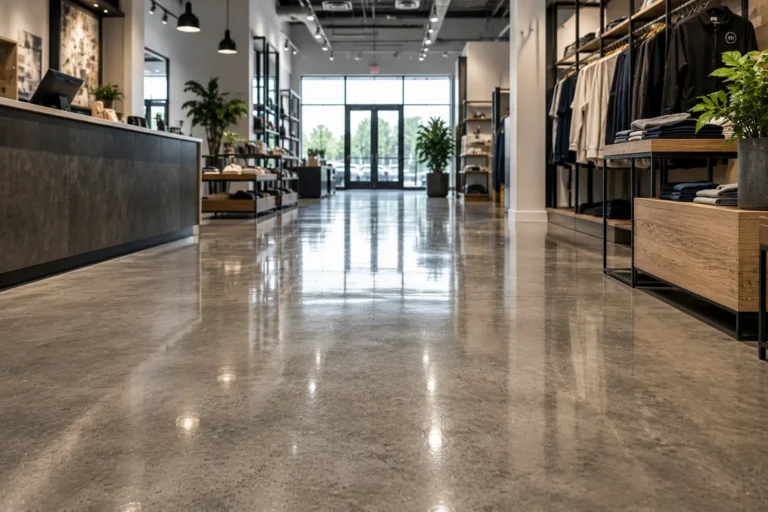
- Retail stores
- Hospitals
- Schools
- Airports
- Automotive facilities
- Food processing plants
A properly selected coating can significantly extend the service life of a commercial concrete floor while reducing long-term maintenance costs.
Why Commercial Facilities Use Concrete Floor Coatings
Commercial floor coatings help businesses:
- Protect concrete from wear and abrasion
- Resist chemicals and oil spills
- Improve slip resistance
- Reduce dusting
- Simplify cleaning
- Improve appearance
- Minimize maintenance downtime
- Extend floor lifespan
Types of Commercial Concrete Floor Coatings
Epoxy Floor Coatings
Epoxy coatings are among the most widely used commercial flooring systems because they provide exceptional durability, strong adhesion, and attractive finishes.
Best for:
- Warehouses
- Manufacturing
- Retail
- Distribution centers
- Aircraft hangars
Advantages
- Heavy-duty protection
- Chemical resistance
- Excellent abrasion resistance
- Available in many finishes and colors
- Long service life
Limitations
- Longer curing time
- Requires dry concrete
- UV exposure may cause yellowing

Polyurethane Floor Coatings
Polyurethane coatings provide greater flexibility than epoxy and perform exceptionally well in environments exposed to impact, vibration, or thermal movement.
Best for
- Industrial facilities
- Warehouses
- Automotive
- Mechanical rooms
Advantages
- Excellent chemical resistance
- High abrasion resistance
- UV stable
- Flexible under impact
Limitations
- Higher material cost
- More complex installation
Polyaspartic Floor Coatings
Polyaspartic coatings have become increasingly popular because they cure rapidly while maintaining excellent durability.
Best for
- Facilities requiring minimal downtime
- Retail
- Healthcare
- Commercial entrances
Advantages
- Fast installation
- UV resistant
- Excellent appearance
- Durable finish
Limitations
- Short working time
- Requires experienced installers
Urethane Cement
Urethane cement is one of the toughest commercial flooring systems available.
Best for
- Food processing
- Beverage production
- Commercial kitchens
- Pharmaceutical facilities
Advantages
- Thermal shock resistance
- Chemical resistance
- Heavy impact resistance
- Moisture tolerant
Limitations
- Industrial appearance
- Higher installation cost
MMA (Methyl Methacrylate)
MMA flooring cures extremely quickly, even in cold temperatures.
Best for
- Refrigerated warehouses
- Food production
- Cold storage
- Manufacturing
Advantages
- Rapid curing
- Cold-weather installation
- Minimal downtime
Limitations
- Strong odor during installation
- Higher installation complexity
Acrylic Concrete Sealers
Acrylic sealers provide basic surface protection while improving appearance.
Best for
- Decorative commercial spaces
- Light traffic areas
Advantages
- Affordable
- Easy maintenance
- Improved appearance
Limitations
- Lower durability
- Requires more frequent maintenance
ESD (Anti-Static) Floor Coatings
ESD coatings safely dissipate static electricity in sensitive work environments.
Best for
- Electronics manufacturing
- Laboratories
- Data centers
- Medical equipment facilities
Advantages
- Static protection
- Equipment safety
- OSHA-friendly environments
Decorative vs Protective Concrete Coatings
Some coatings focus primarily on aesthetics, while others prioritize performance.
| Coating Type | Best For | Durability | Chemical Resistance |
|---|---|---|---|
| Epoxy | Warehouses, Retail, Manufacturing | Excellent | Excellent |
| Polyurethane | Industrial Facilities, Automotive | Excellent | Excellent |
| Polyaspartic | Retail, Healthcare, Fast Turnaround Projects | Excellent | Very Good |
| Urethane Cement | Food Processing, Commercial Kitchens | Outstanding | Outstanding |
| MMA (Methyl Methacrylate) | Cold Storage, Manufacturing | Excellent | Excellent |
| Acrylic Sealer | Light Commercial Areas | Moderate | Moderate |
| ESD (Anti-Static) | Electronics, Laboratories, Data Centers | Excellent | Good |
How to Choose the Right Commercial Floor Coating
Consider:
- Traffic volume
- Forklift activity
- Chemical exposure
- Moisture levels
- Cleaning requirements
- Desired appearance
- Installation timeline
- Budget
- Facility regulations
The best coating depends on how your facility operates rather than selecting the most expensive system.
Conclusion
Choosing the right commercial concrete floor coating is an investment in the long-term performance of your facility. The right system protects your concrete, minimizes maintenance, improves safety, and reduces operational downtime.
Whether your facility requires a heavy-duty epoxy system, fast-curing polyaspartic coating, durable urethane cement, or specialized ESD flooring, selecting the proper solution begins with understanding how your floors are used every day.
At TCS Floors, we help businesses across the United States evaluate their facilities and recommend coating systems that deliver long-lasting performance with minimal disruption to operations.
Frequently Asked Questions
The best coating depends on how your floor is used. Factors such as forklift traffic, chemical exposure, moisture, cleaning requirements, and expected downtime all influence the right choice. A warehouse may benefit from epoxy, while a food processing facility often requires urethane cement for superior thermal and chemical resistance.
Epoxy creates a hard, durable surface that performs well in warehouses, retail stores, and manufacturing facilities. Polyurethane is more flexible and offers better resistance to impact, UV exposure, and temperature changes. In many commercial systems, polyurethane is applied as a topcoat over epoxy for added protection.
When properly installed and maintained, epoxy, polyurethane, and urethane cement systems can last many years. The actual lifespan depends on traffic levels, maintenance practices, and the operating conditions within your facility.
In many cases, yes. Work can often be scheduled during evenings, weekends, or in phases to minimize disruption. Fast-curing systems like polyaspartic and MMA coatings can also reduce downtime when a quick return to service is required.
Yes. Most commercial-grade coatings are designed to withstand forklift traffic, pallet jacks, heavy machinery, oil, grease, cleaning chemicals, and other common industrial contaminants. The level of protection depends on the coating system selected.
Compared to untreated concrete, coated floors are much easier to maintain. Routine sweeping, scrubbing, and scheduled maintenance help preserve the finish and maximize the coating’s lifespan while reducing long-term repair costs.
In many cases, an existing concrete floor can be repaired, ground, and prepared before a new coating is applied. If the concrete has significant structural damage, repairs may be needed before installation. A professional assessment can determine the best approach.