
Industrial facilities present floor-cleaning challenges that routine janitorial methods are not designed to handle. Heavy machinery, forklift traffic, oil, grease, dust, production residue, damaged concrete, and limited maintenance windows can quickly overwhelm a basic cleaning program.
The problem is not always a lack of cleaning. In many facilities, the wrong equipment, products, schedule, or maintenance process is being used for the floor and contamination involved.
Quick answer: The most common industrial floor cleaning challenges are heavy contamination, persistent dust, limited downtime, slip risks, floor or coating damage, and inconsistent maintenance. Solving them requires a site-specific plan that matches the cleaning process, equipment, chemicals, and service schedule to the facility’s floor type and operational demands.
Why Are Industrial Floors Difficult to Clean?
Industrial floors experience conditions that are uncommon in offices and other light-commercial properties.
A warehouse, manufacturing plant, distribution center, or production facility may deal with:
- Forklift and equipment traffic
- Oil, grease, and chemical residue
- Tire and wheel marks
- Concrete dust
- Metal shavings and packaging debris
- Product spills
- Uneven or damaged surfaces
- Existing epoxy coatings or sealers
- Continuous operations
- Restricted access around machinery
- Strict safety and documentation requirements
These factors often occur at the same time. For example, a dusty concrete floor may also contain oil contamination, damaged joints, forklift marks, and areas that cannot be closed during production.
A successful cleaning plan must address the complete floor condition instead of treating every problem as routine surface dirt.
1. Heavy Oil, Grease, and Embedded Contamination
Oil and grease are among the most difficult industrial floor contaminants to remove, particularly from porous or unsealed concrete.
Concrete contains pores that can absorb liquids below the visible surface. Mopping may remove loose residue while leaving absorbed contamination behind. The floor can still look dark, feel slippery, or release oil back to the surface.
Why Routine Cleaning Often Fails
Common reasons include:
- The cleaning product is not suitable for the contaminant
- The degreaser is removed before it has enough dwell time
- The floor is scrubbed without first removing loose debris
- Dirty cleaning solution is redistributed across the floor
- The equipment does not provide enough agitation
- The concrete is unsealed or highly porous
- Oil has penetrated below the surface
- Multiple types of contamination are present
Using more chemical does not necessarily produce a better result. An overly concentrated cleaner may leave residue, damage a coating, or create additional rinsing requirements.
How to Overcome This Challenge
The floor and contaminant should be assessed before cleaning begins. The process may include:
- Removing dry debris
- Applying a compatible industrial degreaser
- Allowing controlled dwell time
- Mechanically agitating the floor
- Recovering the contaminated solution
- Rinsing the surface
- Repeating the process where necessary
- Evaluating whether deeper restoration is required
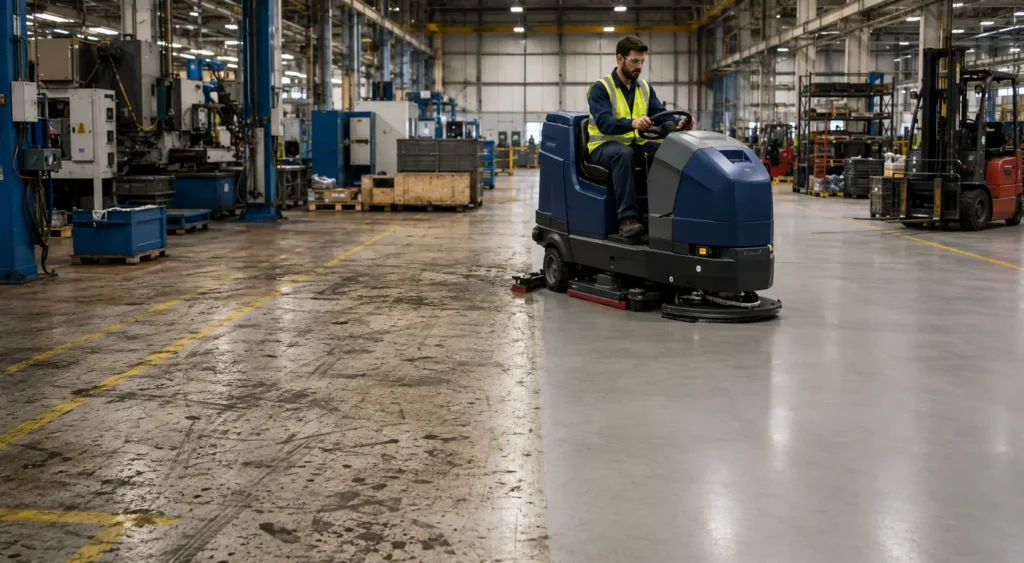
An industrial autoscrubber, rotary floor machine, wet vacuum, or controlled pressure-cleaning system may be used depending on drainage, access, and the floor condition.
Deeply absorbed oil may not be completely removable through cleaning alone. The area may require additional surface preparation, concrete grinding, sealing, or a compatible coating system.
Learn more about professional concrete floor scrubbing.
2. Constant Dust, Dirt, and Production Debris
Industrial facilities can generate significant amounts of dust and debris through manufacturing, packaging, loading, storage, and vehicle movement.
Common materials include:
- Concrete dust
- Cardboard particles
- Packaging fragments
- Wood dust
- Sand and soil
- Metal shavings
- Tire debris
- Product residue
- Dust entering through loading doors
- Debris carried by forklifts and carts
If abrasive particles remain on the floor, equipment and foot traffic can grind them into the surface. This may contribute to scratches, coating wear, airborne dust, and premature deterioration.
Why the Dust Keeps Returning
Recurring dust may be caused by more than inadequate sweeping. Potential sources include:
- Dusting or deteriorating concrete
- Unsealed concrete
- Damaged coatings
- Open loading areas
- Poor entrance matting
- Inadequate dust collection
- Production processes
- Cracks and deteriorated joints
- Cleaning equipment that redistributes fine dust
A facility can sweep daily and still experience dust when the floor itself is producing fine particles.
How to Overcome This Challenge
The first step is identifying whether the dust is being brought into the building, generated by operations, or released by the concrete.
A maintenance plan may include:
- Industrial sweeping
- HEPA-filtered vacuuming where appropriate
- Autoscrubbing
- Cleaning beneath racks and equipment
- Entrance and loading-area controls
- More frequent service in high-production zones
- Repairing damaged concrete
- Applying a suitable concrete sealer
- Installing a dustproofing treatment
When concrete dusting is the underlying problem, routine cleaning may only manage the symptoms. Professional concrete dustproofing or concrete floor sealing may help reduce the release of surface dust.
3. Limited Downtime and Restricted Facility Access
Many industrial facilities cannot stop production for floor cleaning. Warehouses may operate around the clock, while distribution centers must work around deliveries, loading schedules, inventory movement, and seasonal demand.
This creates several planning challenges:
- The entire floor cannot be closed at once
- Forklift routes must remain available
- Cleaning must occur between shifts
- Certain machines cannot be moved
- Security escorts may be required
- Water or electrical access may be limited
- Cleaning cannot interfere with production
- The floor must return to service quickly
A rushed project can lead to incomplete cleaning, wet areas, residue, missed sections, or damage caused by reopening a treated floor too soon.
How to Overcome This Challenge
Industrial floor cleaning should be planned around operations rather than scheduled as an isolated janitorial task.
Possible solutions include:
- Dividing the facility into service zones
- Cleaning one traffic lane at a time
- Scheduling work at night or on weekends
- Using planned shutdowns or maintenance periods
- Coordinating with operations and safety teams
- Establishing temporary pedestrian and equipment routes
- Selecting equipment with faster water recovery
- Confirming drying or curing requirements in advance
- Prioritizing the most contaminated areas first
- Using recurring service visits instead of one large closure
For facilities with multiple shifts, production zones, or locations, a documented floor-care program can make service timing more predictable.
TCS Floors provides commercial floor maintenance programs that can be coordinated around operating schedules and facility access requirements.
4. Slippery Floors and Moisture Control
Industrial floors may become slippery because of oil, grease, water, cleaning residue, worn finishes, smooth coatings, dust, or tracked-in contaminants.
Cleaning can also temporarily create a slip risk if the process leaves excessive water or chemical residue behind.
OSHA requires walking-working surfaces to be kept clean, orderly, and sanitary. Workroom floors must also be maintained in a clean and, to the extent feasible, dry condition. When wet processes are used, appropriate drainage and dry standing areas may be required. OSHA 29 CFR 1910.22
Common Causes of Slippery Industrial Floors
- Oil or coolant leaks
- Overspray from production processes
- Standing water
- Inadequate drainage
- Dirty cleaning solution
- Excess detergent
- Poor rinsing
- Damaged autoscrubber squeegees
- An incompatible finish or sealer
- Worn coating systems
- Smooth surfaces contaminated by fine dust
- Floors reopened before drying
How to Overcome This Challenge
A complete response should address both the contamination and its source.
The facility may need to:
- Repair leaks
- Improve spill-response procedures
- Maintain drainage systems
- Use compatible cleaning chemicals
- Recover dirty water thoroughly
- Rinse away remaining residue
- Inspect cleaning equipment and squeegees
- Restrict access while floors are wet
- Use warning signs and temporary barriers
- Review the suitability of the existing finish or coating
- Establish more frequent cleaning in high-risk areas
Cleaning alone cannot correct every traction problem. A polished, sealed, coated, or finished surface should be evaluated before changing chemicals or using aggressive equipment.
5. Damaged Concrete, Coatings, and Floor Joints
Some floors remain difficult to clean because the surface is already damaged.
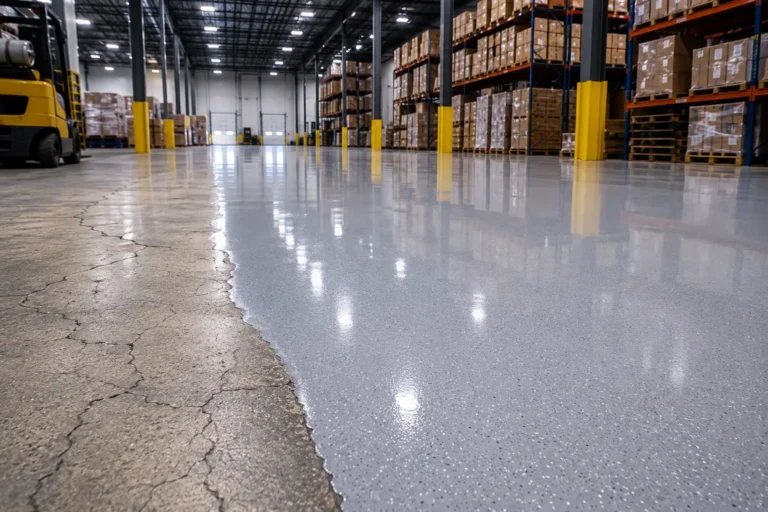
Cracks, spalling, pitting, worn coatings, failed sealers, and deteriorated joints can trap dirt, moisture, oil, and production residue. Cleaning equipment may remove surface contamination without correcting the areas where it continues to collect.
Signs That Cleaning May Not Be Enough
- Concrete continues to release dust
- Cracks repeatedly fill with dirt
- Oil stains return after cleaning
- The coating is peeling or delaminating
- Bare concrete is exposed through worn areas
- The floor has deep scratches or pitting
- Water collects in damaged sections
- Tire marks penetrate the worn coating
- The surface is uneven or difficult to scrub
- Cleaning results vary across the same floor
How to Overcome This Challenge
The facility should first determine whether it needs cleaning, restoration, or surface preparation.
Depending on the condition, the appropriate service may include:
- Deep concrete scrubbing
- Coating removal
- Concrete grinding
- Crack or joint repair
- Concrete restoration
- Polishing
- Sealing
- Dustproofing
- Applying a protective coating
- Installing a concrete overlay
Aggressive cleaning should not be used as a substitute for necessary repairs. It may worsen a failing coating or further expose deteriorated concrete.
Professional concrete floor restoration can address problems that routine cleaning cannot correct.
6. Inconsistent Cleaning Across Large or Multiple Facilities
Industrial floor conditions can vary significantly within one building. Loading zones, production areas, storage aisles, employee spaces, and entrances may each experience different traffic and contamination.
The challenge becomes greater for businesses managing several facilities across different states.
Common problems include:
- Different cleaning methods at each location
- Inconsistent contractor performance
- Incorrect products or equipment
- Missed service areas
- Limited documentation
- Unclear maintenance responsibilities
- Reactive cleaning instead of planned maintenance
- Different appearance and safety standards
- Difficulty verifying completed work
- Repeated emergency restoration
How to Overcome This Challenge
A standardized floor-care program should define:
- The flooring and coating in each area
- The type of contamination present
- Required cleaning methods
- Approved chemicals and equipment
- Service frequencies
- High-priority areas
- Access and scheduling requirements
- Drying and reopening procedures
- Inspection standards
- Before-and-after documentation
- Escalation procedures for damaged floors
- Responsible facility and contractor contacts
A national or multi-location program can help procurement and facility teams work with fewer vendors while maintaining clearer service standards.
TCS Floors coordinates commercial floor care for eligible facilities and multi-location operations across the United States.
How to Build an Effective Industrial Floor Cleaning Plan
An effective plan begins with the floor rather than the machine or cleaning product.
Step 1: Identify the Floor System
Confirm whether the floor is:
- Bare concrete
- Sealed concrete
- Polished concrete
- Epoxy-coated concrete
- Another coated surface
- VCT or resilient flooring
- Ceramic tile and grout
- A combination of surfaces
The same chemical or brush should not automatically be used across every floor type.
Step 2: Identify the Contaminants
Document whether the facility is dealing with:
- Dry dust
- Abrasive debris
- Oil
- Grease
- Tire marks
- Food or product residue
- Chemicals
- Adhesives
- Existing coatings
- General tracked-in soil
The contaminant determines the required chemistry, agitation, recovery, and disposal process.
Step 3: Define the Required Result
Routine cleaning, deep cleaning, restoration, and surface preparation are different services.
The facility should clarify whether the objective is to:
- Improve general cleanliness
- Remove oil or grease
- Reduce dust
- Restore appearance
- Prepare for an inspection
- Correct a failing coating
- Prepare concrete for sealing
- Restore traction
- Remove an old coating
- Establish recurring maintenance
Step 4: Coordinate the Service Window
Determine:
- Which areas can be closed
- How long they can remain closed
- Whether work must be phased
- When employees and equipment can return
- Where water and electrical access are located
- Whether loading routes must remain open
- What security or documentation is required
Step 5: Select the Equipment and Process
The project may require several types of industrial floor cleaning machines, including sweepers, autoscrubbers, rotary machines, industrial vacuums, pressure-cleaning equipment, or concrete grinders.
Equipment should be selected after the flooring, contamination, layout, and intended result are understood.
Step 6: Inspect and Document the Results
After service, inspect:
- High-traffic lanes
- Edges and corners
- Areas beneath accessible equipment
- Cracks and joints
- Loading zones
- Spill-prone areas
- Previously damaged sections
- Floor dryness
- Remaining residue
- Areas requiring repair or follow-up treatment
Before-and-after photos and service records can help facility teams verify completed work and plan future maintenance.
When Should You Hire an Industrial Floor-Care Contractor?
A specialized contractor may be appropriate when:
- Routine janitorial cleaning is no longer effective
- Oil, grease, or residue remains after cleaning
- The concrete is releasing dust
- The floor has a failed sealer or coating
- Specialized machinery is required
- Production cannot tolerate an unplanned shutdown
- Multiple locations need consistent service
- The facility needs before-and-after documentation
- A restoration project must be completed before an inspection or reopening
- The maintenance team is unsure whether the floor needs cleaning, grinding, polishing, sealing, or coating
A floor assessment can prevent the facility from using an unnecessarily aggressive process or repeatedly paying for cleaning that does not address the underlying problem.
Professional Industrial Floor Cleaning Services
TCS Floors provides commercial and industrial floor cleaning, restoration, protection, and maintenance services across the United States.
Services include:
- Industrial floor cleaning
- Warehouse floor cleaning
- Commercial floor cleaning
- Concrete floor scrubbing
- Concrete floor grinding
- Concrete floor polishing
- Concrete floor sealing
- Concrete floor restoration
- Concrete floor coatings
- Floor-care maintenance programs
Projects can be planned around production schedules, delivery windows, shift changes, inspections, shutdowns, and other facility requirements.
Commercial and industrial facilities only. Residential floor cleaning is not provided.
Request an Industrial Floor Assessment
If repeated cleaning is not solving your facility’s floor problems, the surface may require a different process, equipment system, or maintenance schedule.
TCS Floors can assess the floor type, coating, contamination, traffic, damage, and operating requirements before recommending the appropriate cleaning or restoration service.
Request an instant quote or call 866-607-8659 to discuss your industrial floor-care needs.
Frequently Asked Questions
What is the biggest challenge when cleaning industrial floors?
Heavy and varied contamination is one of the biggest challenges. Oil, grease, dust, tire marks, production residue, and loose debris may require different chemicals, equipment, and cleaning processes.
Why does an industrial concrete floor still look dirty after cleaning?
Concrete can absorb oil and other contaminants below the surface. Dirt may also remain inside cracks, pores, joints, or damaged coatings. The floor may require deeper scrubbing, degreasing, grinding, restoration, or sealing.
How do you clean oil from an industrial concrete floor?
The general process may include removing dry debris, applying a compatible degreaser, allowing dwell time, mechanically scrubbing the floor, recovering the contaminated solution, and rinsing. Deeply absorbed oil may require repeated treatment or mechanical surface preparation.
How can an industrial facility reduce floor-cleaning downtime?
Cleaning can be completed in phases, scheduled between shifts, or performed during nights, weekends, and planned shutdowns. Fast-recovery equipment and clearly defined reopening times can also reduce disruption.
Why does concrete dust keep returning after cleaning?
The concrete itself may be deteriorating or dusting. Sweeping and scrubbing can remove loose material, but a dustproofing treatment, sealer, restoration process, or coating may be needed to address the source.
Can an autoscrubber clean every industrial floor?
No. Autoscrubbers are useful for many large hard-surface areas, but they cannot correct every contaminant, damaged coating, or deteriorated concrete surface. Some floors require sweeping, degreasing, rotary scrubbing, grinding, pressure cleaning, or restoration.
How often should an industrial floor be professionally cleaned?
The schedule depends on production activity, traffic, floor type, contamination, safety requirements, and appearance standards. High-use areas may require frequent cleaning, while deeper restoration can be scheduled periodically.
Can industrial floor cleaning be completed while a facility remains operational?
In many cases, yes. The project may be divided into zones so that production routes, loading areas, and essential operations remain available. The exact plan depends on the facility layout and safety requirements.