
Industrial floor cleaning machines fall into a few families: sweepers, automatic scrubbers, single-disc machines, burnishers, industrial vacuums, pressure washers and grinders. Each does one job. A sweeper lifts dry debris, a scrubber washes and recovers the water, and a grinder changes the concrete itself.
No single machine fits every floor. The right choice depends on what is on the floor, what the floor is made of, and what result you need. The right cleaning agent matters just as much, so this guide covers both.
Types of industrial floor cleaning machines
These are the machine names you will see on quotes and spec sheets. Most projects use two or three of them in sequence. For help choosing, our industrial floor cleaning services team starts from the floor and the soil, never from the machine.
Industrial sweepers
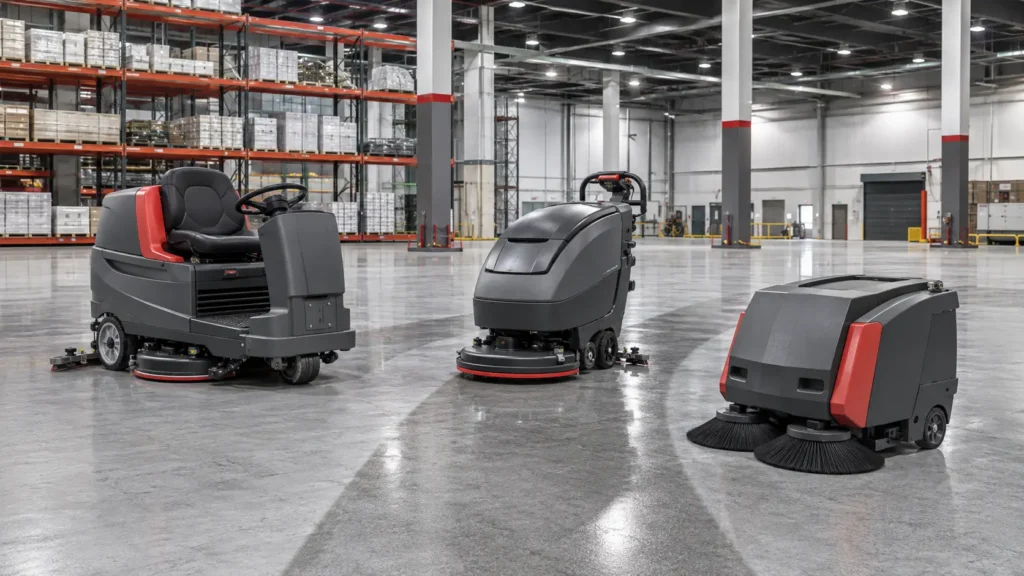
A sweeper uses rotating brushes to collect dry dust, packaging debris, sand and metal fragments. Push, walk-behind and ride-on versions exist, and some combine sweeping with scrubbing.
Sweeping is a dry step. It does not remove bonded grease, stains or embedded soil. Use it first, so grit does not scratch the floor during the wet pass.
Automatic floor scrubbers
An automatic scrubber, also called a scrubber-dryer or autoscrubber, applies solution, scrubs with brushes or pads, and recovers the dirty water in one pass. It is the main machine for warehouse, plant, retail and school floors.
A scrubber only works as well as its squeegee and its recovery system. A worn blade leaves moisture behind, and a wet floor is a slip risk.
Single-disc floor machines
A single-disc machine, also called a rotary machine or monobrush, spins one pad or brush. With the right pad it scrubs, strips old finish, cleans edges or agitates heavily soiled concrete.
It gives more controlled agitation than a scrubber in tight areas. It also punishes a wrong pad or too much pressure, so match the pad to the floor.
Floor burnishers
A burnisher is a high-speed machine that uses heat and friction to restore gloss on a compatible finish, usually on vinyl composition tile. It maintains a finish. It does not replace one that is missing, peeling or built up.
Industrial vacuums
Industrial vacuums pick up dry debris, fine dust, liquids or both. Dry, wet and dry, and HEPA-filtered units exist. Fine concrete dust and any hazardous residue need the right filtration, so identify what you are collecting before you pick the unit.
Pressure washers and steam equipment
Pressure washers use water pressure to lift dirt and grease. Hot-water units work well on oily loading areas and service bays. They are a poor fit for many interior floors, because water gets into joints, walls, equipment and drains that cannot handle it.
Steam equipment suits tile and grout. Heat can damage some coatings and adhesives, so confirm the surface first.
Concrete grinders
A grinder uses diamond tooling to remove coatings, residue and surface material. It is preparation for sealing, coating or polishing.
It is not cleaning. If the floor only carries soil, scrubbing is the right tool, and grinding takes off concrete you did not need to lose.
Advantages of a floor cleaning machine
For a facility manager, the case for machines is simple. A machine cleans more floor in less labour time, and it cleans the same way every time.
- Coverage: one operator covers large areas that would take a crew with mops.
- Recovery: scrubbers pick up dirty water, so grease and soil leave the building and do not spread.
- Safer floors: less standing water and less film means fewer slips.
- Floor life: regular mechanical cleaning prevents the buildup that wears coatings and concrete.
- Less downtime: faster cleaning means shorter closures of aisles and production areas.
Check this week how your floors are cleaned today. If the answer is a mop and bucket in a large building, you are paying for labour that a machine does better.
Walk-behind or ride-on machines
Size the machine to the open floor you can actually use, not the total size of the building. Racking, equipment and walls decide what fits.
Walk-behind machines suit narrow aisles, divided rooms and areas with many obstacles. Ride-on machines suit large, open warehouses, distribution centers and plants. They cover more ground, but they need turning room, safe travel routes, storage and charging space.
Many buildings need both. Ride-on machines handle the open areas, and walk-behind units handle the aisles and edges.
Industrial floor cleaners and cleaning agents
The best industrial floor cleaner is the one made for your floor and your soil. A strong product on the wrong floor causes damage. Match the agent to the soil first, then confirm it suits the surface.
- Neutral cleaners: for routine cleaning and for sealed, polished or coated floors. They are the safe default.
- Alkaline degreasers: for oil, grease, tire marks and food residue on raw concrete. They can dull or haze coatings, so test first.
- Acidic cleaners: for mineral deposits and rust staining on suitable surfaces. They can etch concrete and harm sealers.
- Solvent-based products: for adhesives and some stubborn residue. Use them sparingly and with ventilation.
- Enzyme and bio-based products: for organic soil and odor in food and drain areas.
Four rules apply to every agent. Follow the dilution on the label. Give it dwell time, but do not let it dry on the floor.
Recover it fully and rinse when the label says so. Test a small, hidden spot before you treat a whole floor.
Never use household products on an industrial floor. They are not built for the soil load, and many leave a film that makes the floor slick.
Match the machine and agent to your floor
Raw and sealed concrete
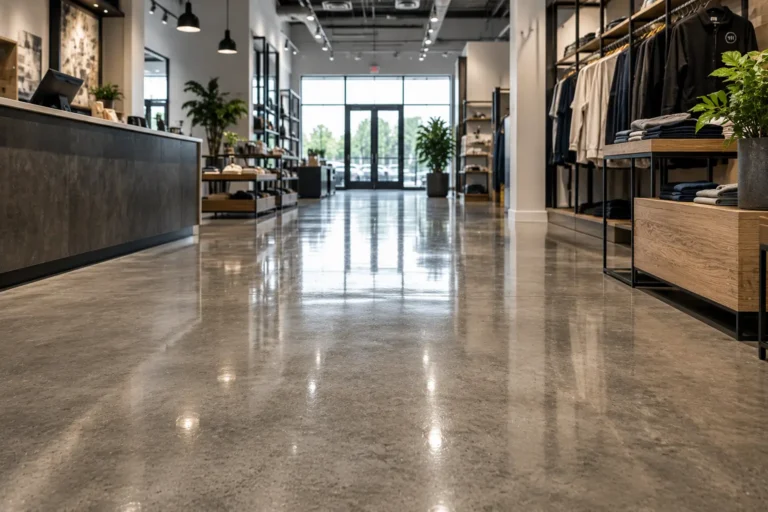
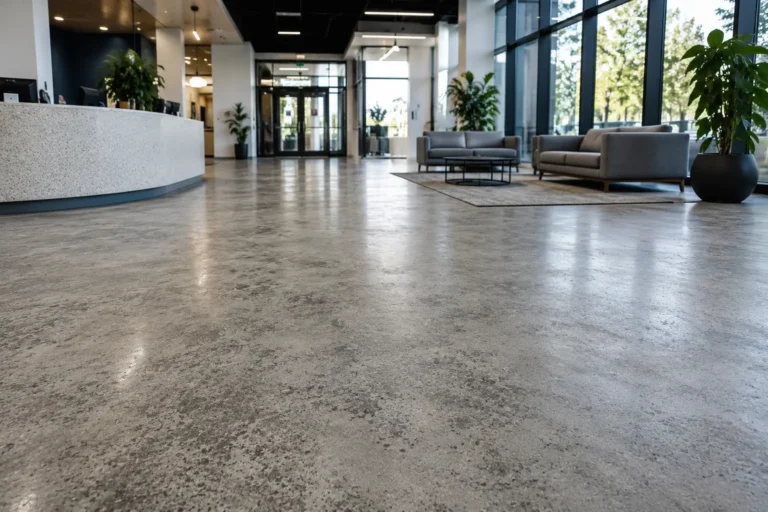
Raw concrete takes a medium brush and a stronger degreaser. Sealed or polished concrete needs soft pads and neutral cleaners to protect the finish. For heavy buildup on concrete, see concrete scrubbing.
Vinyl composition tile
Tile with a finish is cleaned with a scrubber or rotary machine and then burnished. If the finish is worn through, it needs stripping and recoating, not more burnishing.
Epoxy and coated floors
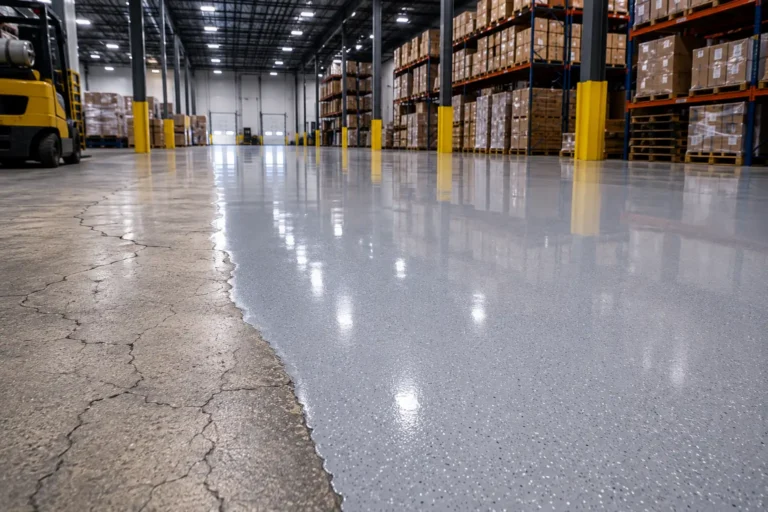
Use non-abrasive pads and neutral cleaners. Aggressive brushes and strong solvents scratch or cloud the coating.
Ceramic tile and grout
Use brushes that reach into grout lines, and recover the water fully. Steam works here if the tile and grout allow it.
Buy machines or hire a contractor
Buying makes sense when you have operators, storage, and a steady daily cleaning need. The machine is only part of the cost. You also carry batteries and chargers, brushes, pads and squeegees, repairs, chemicals, wastewater handling and operator time.
Hire a contractor for restoration, deep cleaning, grinding, coating prep and multi-site programs. These jobs need several machines, and you would not use them every day. Many facilities do both: staff handle daily sweeping and spills, and a contractor handles the periodic work.
Planning the work in your building
To get an accurate quote, send the approximate square footage, photos of the floor, the floor type, and the hours you can give us. Photos of the worst areas help most.
We schedule at night and on weekends, so production, receiving and customers keep moving. We build customized maintenance programs around your soil load and traffic, so deep cleaning happens before buildup gets expensive to remove.
TCS Floors works on commercial and industrial buildings only, nationwide, with 33+ years of experience in commercial floor care.
Frequently asked questions
What is the best machine for cleaning an industrial floor?
No single machine is best. An automatic scrubber is the main machine for most large hard floors.
Sweepers handle dry debris first, and grinders prepare concrete for coatings. The right choice depends on the floor and the soil.
What is the difference between a sweeper and an autoscrubber?
A sweeper collects loose, dry debris. An autoscrubber applies solution, scrubs, and recovers the dirty water. Sweep first, then scrub.
What is the best industrial floor cleaner?
It is the product matched to your floor and soil. Neutral cleaners suit routine work and coated floors.
Alkaline degreasers suit oil and grease on raw concrete. Always follow the label and test a small spot first.
Can an autoscrubber remove oil from concrete?
It can remove surface oil with the right degreaser, brush, dwell time and full recovery. Oil that has soaked deep into the concrete may need repeated treatment or a restoration process.
Can a concrete grinder be used for routine cleaning?
No. A grinder removes surface material and is used for restoration and preparation. Use sweeping, scrubbing and degreasing for routine soil.
Are ride-on scrubbers better than walk-behind machines?
Ride-on machines are better for large, open areas. Walk-behind machines are better for narrow aisles and crowded rooms. Many buildings need both.