

Updated November 7, 2026 · 9-minute read · Sources linked at the end
Choose polished concrete for dry, busy floors: warehouses, retail, schools and offices. It usually costs less to put in, and it has no coating that can peel. Choose epoxy where the floor gets wet, sees chemicals or needs color-coded zones. Test the slab for moisture first.
Many buildings use both: polished concrete where people and forklifts move, epoxy where spills happen.
Find your floor in 60 seconds
Answer six questions about your space. The tool scores both floors and tells you why. It runs in your browser and saves nothing.
Which floor fits your space?
A first read only. A site visit and a slab moisture test decide the final pick.
Polished concrete vs epoxy, side by side
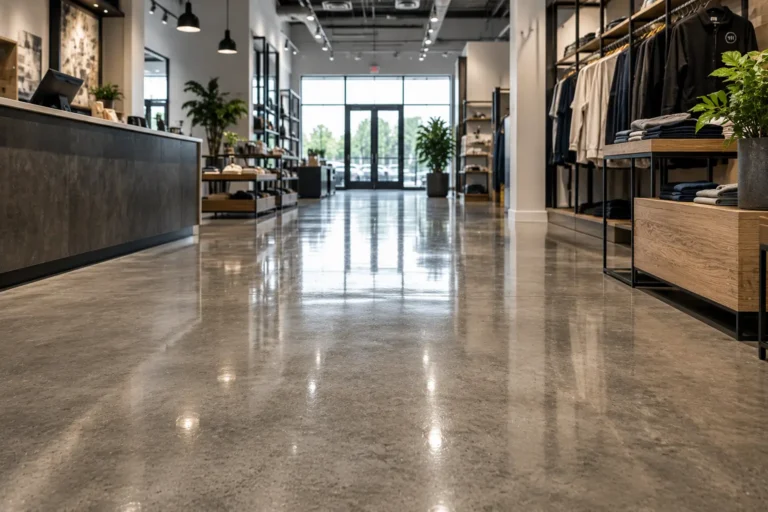
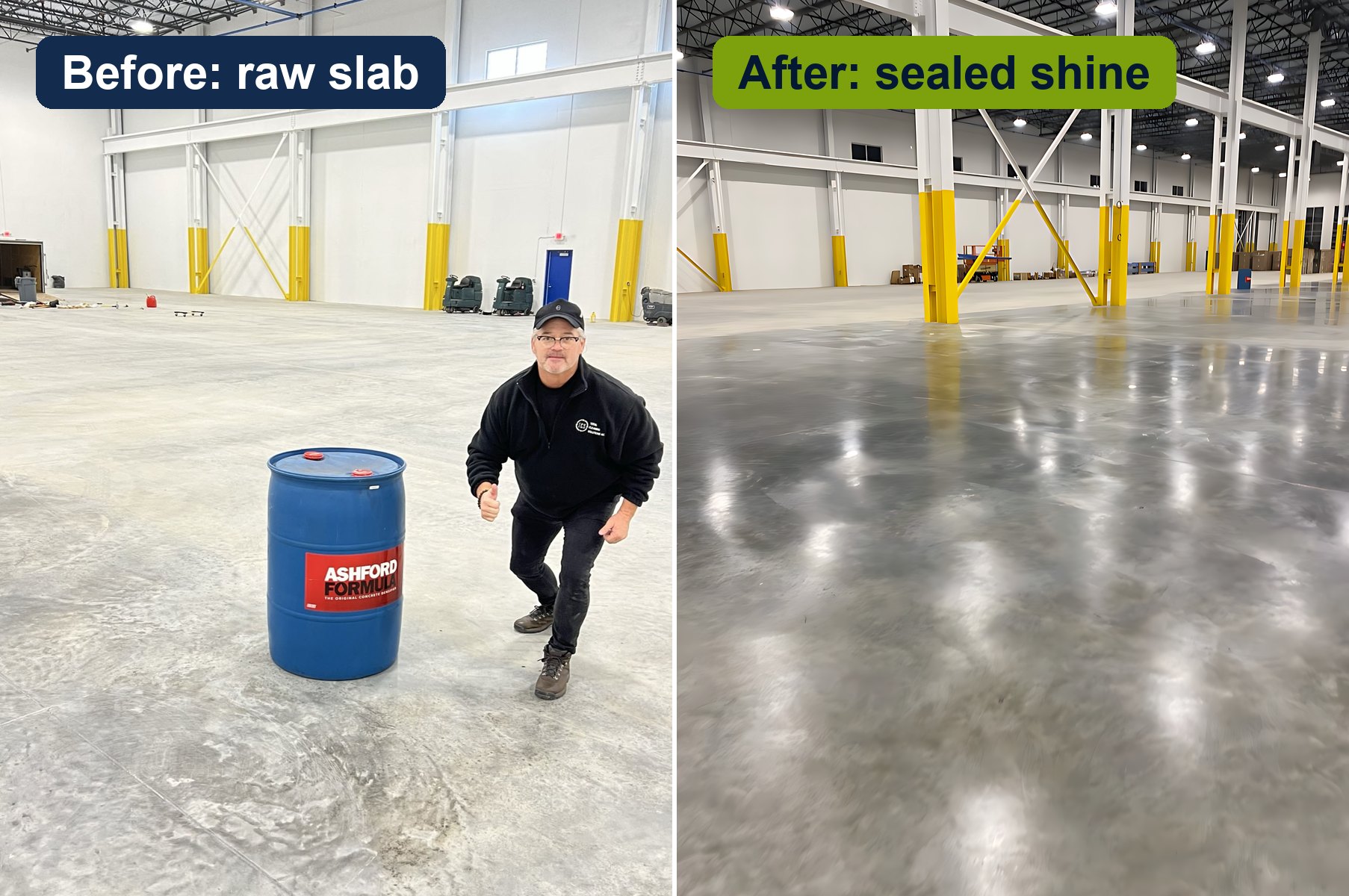
Polished concrete is your own slab, ground and polished in steps until it shines. A hardener soaks in and makes the top harder. Nothing sits on top, so nothing can peel off.
Epoxy is a coating. A crew grinds the slab, then pours a layer of resin that cures into a hard, sealed skin. You can pick the color, add grit for grip and mark zones and walkways.
| What you care about | Polished concrete | Epoxy coating |
|---|---|---|
| Installed cost | Usually lower: $2 to $6 per sq ft in one guide, $3 to $12 in another 1,2 | $3 to $12 per sq ft 1, more for thick quartz or chemical-grade systems 3 |
| What can fail | No coating, so no peeling. It “never requires complete removal” 4 | Can bubble or lift if the slab holds moisture 5, and chip under hard impacts 7 |
| Life | The floor stays. You re-polish worn lanes as needed 2 | 5 to 10 years in heavy use, recoat after 8 to 10 years in busy areas 3 |
| Daily care | Dust mop and auto-scrub. Keep grit off the floor 2 | Sweep and mop 3 |
| Spills and chemicals | Resists oil and chemical stains when cleaned up fast 2. Strong acids and harsh chemicals can etch it 6 | Seals the slab. Built for harsh use and chemical exposure 6 |
| Wet areas | Fine when clean and dry 2. Not the pick for wash-down rooms | Grit can be added to the top coat for grip |
| Look | Bright, clean, reflects light, which can cut how much lighting you need 2 | Any color, flakes, quartz, safety lines and zones 6 |
| Downtime | Walkable as soon as the crew finishes a section. Easy to phase | Each coat must cure before traffic. Follow the product label |
Cost now and over time
On the day you pay, polished concrete usually costs the same or less. Cost guides put it at $2 to $6 per square foot in one study and $3 to $12 in another 1,2. A 2026 review of garage floors saw quotes up to $16 for a high-end polish 7.
Epoxy runs $3 to $12 per square foot in the same guide 1. Heavy systems cost more: one 2025 guide priced an 800-square-foot commercial kitchen in quartz epoxy at $5,600 to $9,600, about $7 to $12 per square foot 3.
The bigger gap shows up later. Epoxy is a layer that wears, so plan to recoat it. One 2025 guide gives it 5 to 10 years in heavy use 3. Polished concrete has no layer to replace. You keep it clean and re-polish worn lanes.
These are market ranges, not a TCS quote. Your price depends on the slab: cracks, old coatings, glue, and how much square footage there is. We price after we see the floor.
Replacing an old floor? Polished concrete also beats VCT on upkeep. A 2026 industry review put yearly care at $1.00 per square foot for polished concrete against $2.00 for VCT 4.
Forklifts, chemicals and wear
Polished concrete resists forklift tire marks 2 and has nothing to chip. Epoxy holds up well, but hard wheels and dropped loads can chip it 7.
Why epoxy fails: slab moisture
Most epoxy failures start under the coating. Moisture moves up through the slab, gets trapped under the epoxy and pushes it off. That shows up as bubbles, soft spots and peeling.
The fix is a test before anyone orders material. A 2022 review in Construction Canada found that floors which passed the surface test still failed 5. The surface test only reads the top quarter inch of the slab. The deeper test drills into the slab to 20 or 40 percent of its depth 5.
- Ask for the deeper test (ASTM F2170). It measures relative humidity inside the slab 5.
- Above 80 percent: the review says the slab needs a moisture barrier before the coating 5. Budget for it.
- Polished concrete skips this risk. No coating sits on top to trap moisture.
Best pick by building type
Polished concrete. Huge areas, forklift traffic, low upkeep, no coating to peel. Use epoxy only in charging rooms or spill zones.
Polished concrete. Bright and clean, and it stays open for business while you re-polish lanes.
Polished concrete for halls, lobbies and gyms with a sealed slab. Epoxy for labs and kitchens.
Epoxy or another resin system. Wash-downs and chemicals need a sealed, textured surface. Test the slab first.
Epoxy where oil, fluids and color-coded bays matter. Polished concrete where traffic is dry.
Depends on the room. Polished concrete for halls and lobbies. A sealed resin floor for wet and clinical rooms.
When to use both
You do not have to pick one floor for the whole building. A common plan is polished concrete across the open floor, and epoxy in the rooms that get wet or see chemicals: battery charging, wash bays, kitchens and labs.
One crew can grind the whole slab, then polish the open areas and coat the special rooms. You get the low upkeep of polished concrete where most of your square footage is, and protection where you need it.
Want a straight answer for your floor?
Send the square footage, the building type and two photos of the slab. We tell you which floor fits, and why. TCS Floors works only on commercial floors, nationwide, with night and weekend crews so you stay open.
Related: commercial concrete polishing · concrete floor coatings · epoxy concrete sealer
Questions buyers ask
Is polished concrete cheaper than epoxy?
Usually it costs the same or less. One cost guide puts polished concrete at $2 to $6 per square foot and epoxy at $3 to $12 (Hunker). Polished concrete also has no coating to replace later.
Which lasts longer, polished concrete or epoxy?
Polished concrete has no coating to wear through, so the floor stays and worn lanes get re-polished. Epoxy lasts about 5 to 10 years in heavy-use settings, with a recoat after 8 to 10 years in busy areas (Flooring Clarity, 2025).
Is epoxy or polished concrete better for a warehouse with forklifts?
Polished concrete is usually the better pick for open warehouse floors: it resists forklift tire marks and has nothing to chip. Use epoxy in battery charging rooms and spill zones.
Do I need a moisture test before epoxy?
Yes. Ask for the ASTM F2170 test, which measures relative humidity inside the slab. A 2022 Construction Canada review says slabs with greater than 80 percent RH need a moisture mitigation system before the coating.
Is polished concrete slippery?
Concrete Network says polished floors are safe to walk on when kept clean and dry, and tend to be less slippery than waxed linoleum or polished marble. Keep wet areas dry or choose a textured coating there.
Can I use polished concrete and epoxy in the same building?
Yes. A common plan is polished concrete on the open floor and epoxy in rooms that get wet or see chemicals, such as wash bays, kitchens, labs and battery charging areas.
Sources
- Hunker, Polished Concrete vs. Epoxy. Updated October 3, 2021.
- Concrete Network, Polished Concrete Floors. Updated April 19, 2021.
- Flooring Clarity, How Much Is Epoxy Flooring Per Square Foot?. June 10, 2025.
- Building and Construction, The state of maintenance and polished concrete floors. June 17, 2026.
- Construction Canada, Concrete flooring: mitigating vapour-related failures. May 23, 2022.
- Designing Buildings, Polished concrete vs epoxy flooring. Last edited June 2, 2021.
- SlashGear, Polished Concrete vs. Epoxy: Which Is Better?. June 24, 2026.
Prices are published market ranges, not TCS prices. Every quote was checked on the live page on November 7, 2026.