

Updated November 7, 2026 · 11-minute read · Steps checked against tile maker and industry guidance, linked at the end
To strip and wax a floor, you remove all the old finish with a stripper and a scrubbing pad, rinse and neutralize the floor, then put down thin new coats of finish and burnish them to a shine.
On commercial VCT, the tile maker calls for at least three coats after a strip 1. Most crews build four to six layers 2. Plan it as a closure: the room must stay empty until the last coat is dry.
Plan the labor before you start
Stripping is the slow part. An industry example timed a 1,975-square-foot floor at about six hours for one person to strip and rinse, and two more hours to put down finish 5. The planner scales that example to your floor and your crew.
Strip and wax labor planner
- Strip and rinse: 15 labor hours
- Apply finish: 5.1 labor hours
- Labor cost at your rate: $506 (machines, pads and chemicals not included)
Based on one published job: 1,975 sq ft took about 6 labor hours to strip and rinse and 2 hours to finish (CleanLink, 2015). Layout and buildup factors are planning allowances. Add the dry time between coats from your finish label.
What you need
Commercial floor stripper, neutral cleaner or neutralizer, and a high-quality commercial floor finish. Read every label first.
A floor machine with stripping pads, a wet vacuum for the slurry, and a high-speed burnisher with a polishing pad.
Separate mops and buckets for stripper, rinse and finish. Never use a stripper mop for finish.
Wet floor signs, tape or barriers at every door, gloves, eye protection and non-slip shoes. Stripped floors are very slick.
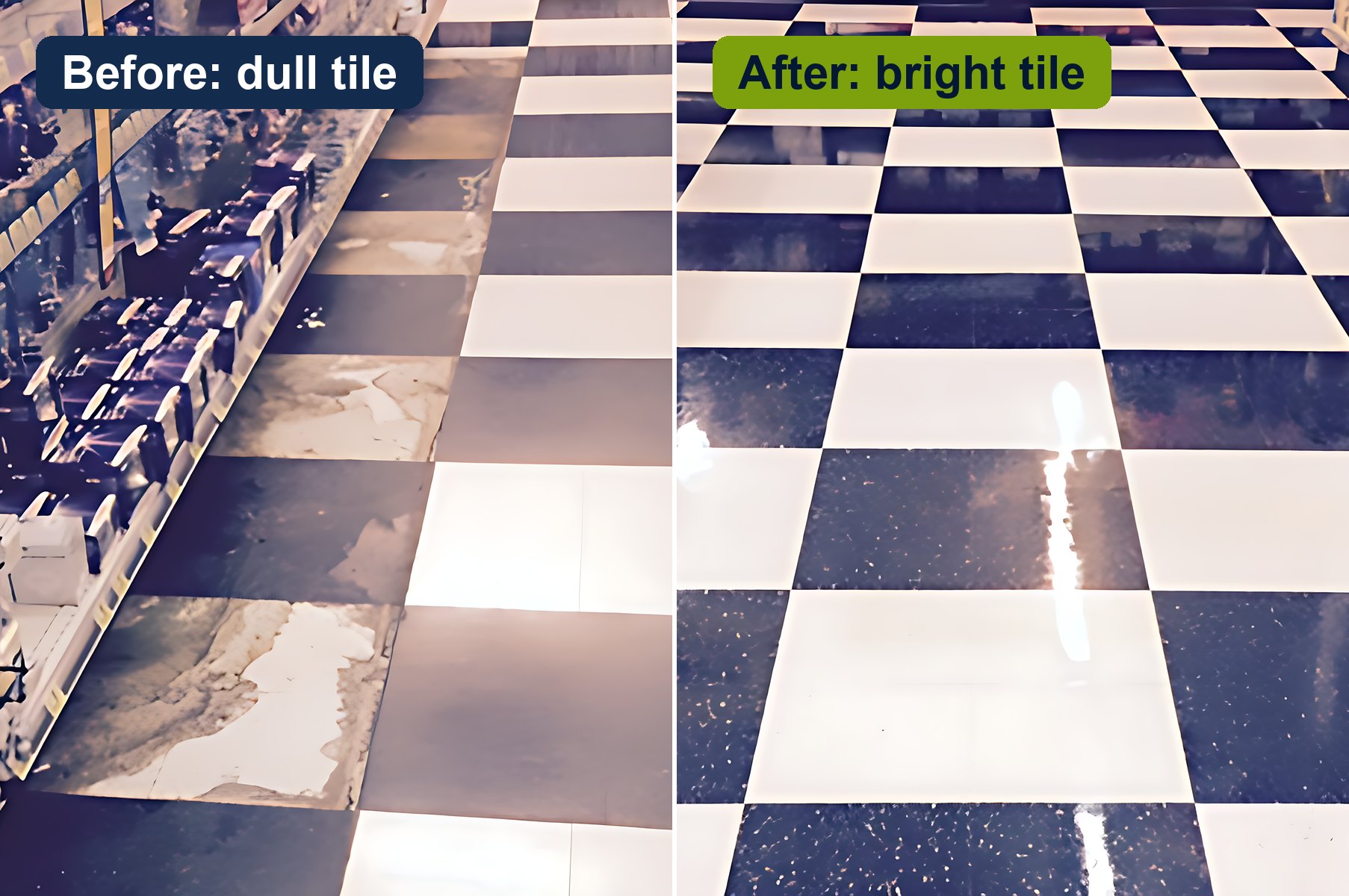
How to strip and wax a floor, step by step
Clear the room and dust mop
Move everything off the floor, close the space and post signs at every entry. Dust mop well. Grit left on the floor scratches the new finish.
Read the labels and mix the stripper
Mix the stripper at the label rate. For Armstrong VCT, the tile maker asks for a stripper with sodium hydroxide at 1% by weight or more 1.
Apply stripper in small sections
Start in the corner farthest from the door. Work in small areas, about 6 feet by 6 feet 3. Let the stripper work for the time on its label. Keep it wet: the tile maker warns never to let stripping solution dry on the floor 1.
Scrub the old finish loose
Run the floor machine with a stripping pad over each section. Do the edges and corners by hand with a pad or scraper. This is where the old wax comes off.
Pick up the slurry right away
Use a wet vacuum to lift the dirty slurry before it dries. Dried slurry sticks back to the tile and the new finish will not bond.
Rinse and neutralize
Mop the floor with clean water and a neutralizer. Stripper leaves the floor alkaline, and that residue reacts with the new finish 4. Plain water rarely takes it all off 4. One university procedure calls for 3 to 5 mop passes with neutral cleaner 3.
Check that all the old finish is gone
Look across the floor at a low angle and inspect it closely. Shiny patches mean finish is still there. Strip those spots again before you go on.
Put down thin coats of finish
Apply finish with a clean mop or applicator in thin, even coats. Let each coat dry fully, as its label says, before the next. Put down at least three coats on VCT after a strip 1. Keep the last coat or two a few inches off the walls, where traffic never reaches.
Burnish and open the room
Once the finish is fully dry, as its label says, burnish it with a high-speed machine to raise the shine. Then open the room. From now on, regular dust mopping and scrubbing keep the floor that way.
Rather not close the building for it?
Our crews strip and wax commercial floors at night and on weekends, so you open on time. Send the square footage and two photos for a quote.
How to remove floor wax
Old floor wax comes off the same way as in steps 2 to 7 above: a stripper made for floor finish, a scrubbing pad, a wet vacuum and a good rinse. The stripper softens the finish so the pad can lift it.
- Only want it gone, not replaced? Still rinse and neutralize. Leftover stripper keeps working on the floor 4.
- Thick, yellow buildup at the edges? Let the stripper work longer there and scrape the corners by hand.
- Buildup on a small spot only? A scrub and recoat may be enough. See the next section.
Strip, scrub and recoat, or burnish?
A full strip is the heaviest job you can do to a VCT floor. One industry publication calls stripping “labor-, chemical-, and water-intensive” 2. Most of the time, a lighter job does the trick.
| Floor looks like this | Do this | Why |
|---|---|---|
| Dull but clean, finish still thick | Burnish | The tile maker says to buff or burnish if about 3 coats of finish remain 1 |
| Worn in walkways, surface scuffs | Scrub and recoat | Scrub off the top layer, then add 1 to 2 coats to bring the gloss back 2. No harsh stripper needed 1 |
| Yellow, dark or dirt trapped in the finish | Full strip and wax | The dirt is inside the layers. Only taking them all off fixes it |
| Finish peeling or worn to the tile | Full strip and wax | There is no good base left to build on |
How often you strip depends on your building. The tile maker says it plainly: “local site conditions will determine” the steps and how often to do them 1. A school hallway and a quiet office are different floors.
New VCT: the first finish
New tile needs finish before it sees traffic, but it also needs time to settle. For its Diamond 10 VCT, Armstrong’s maintenance guide says Apply two coats
of a high-quality commercial floor polish, and to avoid wet washing, machine scrubbing or stripping for at least five days after installation 1.
Other tiles have other rules. Check the maker’s guide for your tile before the first finish goes down.
Mistakes that cost you a re-do
It glues the old finish back down. Work small sections and keep them wet 1.
Alkaline residue reacts with the new finish 4. You get a cloudy, soft or flaking floor.
Thick coats dry slowly and stay soft longer. Thin, even coats dry hard and level.
Foot traffic on soft finish leaves marks you cannot buff out. Follow the finish label for dry and cure times.
Do it in-house or hire it out?
Use the planner above to see the labor hours. Then add what does not show up in hours: machines, pads and chemicals, training, and the risk of a re-do if the finish fails.
| Question | In-house | Hire a crew |
|---|---|---|
| Small rooms, done often | Often cheaper if your team has the machines | Fine, but setup cost per room is higher |
| Large areas, once or twice a year | Ties up your staff for nights or weekends | A full crew finishes in one closure |
| Building must stay open | Hard to staff at night | Night and weekend crews are standard |
| Who owns a bad result | You do | The contractor, under your contract |
Get your floors stripped and waxed without the closure
TCS Floors works only on commercial floors, nationwide. We plan the job around your hours and build a maintenance program, so you strip less often.
Related: commercial VCT strip and wax services · VCT scrub and recoat · burnishing and buffing
Questions people ask
How do you strip and wax a VCT floor?
Clear and dust mop the room, apply stripper in small sections, scrub the old finish loose, pick up the slurry with a wet vacuum, rinse and neutralize, check that all old finish is gone, apply thin coats of finish, and burnish once it is fully dry.
How many coats of floor finish should I apply?
Armstrong's VCT maintenance guide calls for at least 3 coats after stripping. An industry publication says finish is typically applied in four to six layers (Cleaning and Maintenance Management, 2021).
How often should a commercial floor be stripped and waxed?
It depends on the building. The tile maker says local site conditions decide the steps and how often to do them. Regular burnishing and scrub and recoat between strips keep full strips far apart.
What is the difference between stripping and scrub and recoat?
Stripping removes all the finish down to the tile. A scrub and recoat removes only the worn top layer and adds 1 to 2 new coats, which is often enough to restore gloss without a harsh stripper.
Do I need to neutralize the floor after stripping?
Yes. Stripper leaves the floor alkaline, and that residue reacts with the new finish. Plain water rarely removes it all, so rinse with a neutral cleaner or neutralizer (Okum Supply, 2026).
How long does it take to strip and wax a floor?
In one published example, a 1,975 square foot floor took about 6 labor hours to strip and rinse and 2 more to apply finish. The room stays closed longer, because each coat must dry as its label says.
Sources
- Floor Expert (AHF, Armstrong Flooring), Maintenance recommendations for VCT with Diamond 10 technology. Updated April 16, 2026.
- Cleaning and Maintenance Management (ISSA), Rethinking VCT floor maintenance. June 9, 2021.
- Weber State University Facilities Management, Custodial hard floor maintenance procedures. February 1, 2012. Older, but its steps match the 2026 tile maker guidance above.
- Okum Supply, How to properly neutralize floors after stripping. January 9, 2026.
- CleanLink, First In Bidding A Job: Determine Labor Costs. July 1, 2015. Older, used only as a labor-hours example.
Prices are published market ranges, not TCS prices. Every quote was checked on the live page on November 7, 2026.