
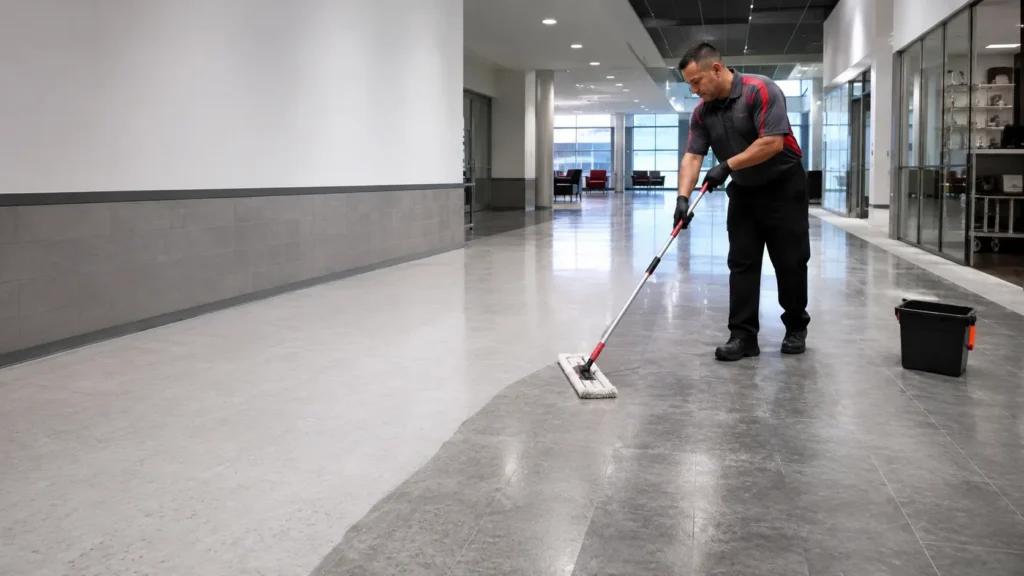
Floor wax is a protective finish applied to a compatible commercial floor, most often vinyl composition tile (VCT). It takes the daily scuffs, soil and wear so the tile underneath does not. Waxing a floor means cleaning it, then applying several thin coats of that finish.
In a store, school, hospital or warehouse, you use it for three reasons: to protect the floor, to keep it looking right for customers and staff, and to make daily cleaning easier.
What is floor waxing?
Floor waxing is the process of applying a protective finish to a floor and keeping it up. The word “wax” is a holdover.
In commercial buildings, most products sold as floor wax are water-based polymer finishes. Traditional wax used natural ingredients such as carnauba.
Once the finish dries and cures, it becomes a sacrificial layer. Traffic wears this layer down instead of the floor. You then burnish it, recoat it, or strip it and start over as its condition changes.
That cycle is why a waxed floor is a maintenance program and not a one-time job. Our commercial VCT strip and wax services cover the full cycle.
Floor wax uses in a commercial building
Floor wax has a short list of jobs. All of them serve one goal: keeping the floor you own in service.
- Protects the floor. The finish absorbs scratches and surface wear from shoes, carts and equipment.
- Keeps the look uniform. A clean, even finish makes the space look kept, from a quiet satin to a high gloss.
- Makes cleaning easier. Dirt and scuff marks hit the finish first, not the tile, so sweeping, mopping and burnishing work better.
- Protects high-traffic zones. Entrances, corridors, checkout lanes, cafeterias and lobbies wear first. A planned program gets to them before the finish fails.
- Delays replacement. Protecting the tile can push back restoration or replacement, which matters across large or multi-location properties.
The results depend on the right product, good prep, careful application, full cure and steady maintenance. A badly applied finish protects nothing.
Why wax floors?
You wax a floor because bare VCT is porous. Without a finish, soil gets into the tile and stays there, and the tile wears faster. The finish gives you something you can clean, burnish and replace, instead of a tile you can only replace.
It is also a cost decision. The finish is the layer you replace so you do not have to replace the flooring.
Floor wax vs. floor finish
People use the two terms to mean the same thing. They are not always identical.
Traditional wax may contain natural ingredients. Modern commercial finishes use synthetic polymers built for adhesion, durability, gloss and machine maintenance.
You will also hear commercial floor wax called floor polish, VCT wax, acrylic floor finish, high-gloss finish or slip-resistant finish. The purpose is the same: a protective, maintainable layer over a compatible floor.
What is floor wax made of?
The mix varies by maker and product. Commercial finishes commonly include acrylic polymers, resins, plasticizers, surfactants, leveling agents, preservatives and water as the carrier. These help the finish spread evenly, bond to the floor, dry properly and take routine traffic.
Products are made for different floors and conditions. A finish that works in an office may be wrong for a busy store, a school corridor or a healthcare facility. Confirm the product with your contractor before work starts.
Which floors can be waxed?
Not every hard floor takes wax. Always confirm the flooring maker’s maintenance requirements first.
Vinyl composition tile
VCT is one of the most commonly waxed commercial floors. It is common in schools, stores, churches, offices, healthcare buildings and government sites. Older VCT with heavy buildup, yellowing or exposed areas may need a strip before a new maintenance cycle can start.
Sealed concrete
Some sealed concrete floors can take a compatible sacrificial finish that protects the sealer. The slab must be inspected first, because porosity, moisture, contamination and sealer compatibility all affect adhesion.
Linoleum and other resilient floors
Some linoleum, sheet vinyl and rubber floors can take a maker-approved finish. Many newer floors arrive with a factory coating that needs a different process. Wax on the wrong surface can peel, discolor or look uneven.
Floors that usually need another treatment
These floors may need cleaning, sealing, polishing or restoration in place of waxing: ceramic and porcelain tile, polished concrete, epoxy, laminate, unfinished wood, natural stone, some luxury vinyl and anything with a factory-applied coating.
If your floor is a “no wax” floor, it has a factory finish that is not meant to be waxed. Treat it as a different floor type and ask for an assessment.
How is floor wax applied?
Professional waxing is more than spreading product. Prep and application decide how long the result lasts.
- Inspect. Check the flooring, existing finish, damage, traffic patterns and service history.
- Clean and prepare. Remove dust, grease, soil and residue. New finish will not bond to a dirty floor.
- Strip if needed. Remove the old finish when it is yellowed, peeling, built up or no longer responding to maintenance. Floors in better shape may only need a deep scrub and recoat.
- Rinse and neutralize. Take off all stripper and cleaning residue.
- Apply thin coats. Several thin, even coats beat one heavy coat. Let each dry before the next.
- Let it cure. Keep furniture, equipment, rolling loads and routine cleaning off the floor until the finish maker’s directions say it can return.
Commercial work can be scheduled at night, on weekends, during school breaks or in planned shutdowns to limit disruption.
When should old floor wax be removed?
Not always. A floor in reasonable condition may only need deep cleaning, burnishing or recoating. Strip when you see:
- Yellow or cloudy finish, or heavy buildup
- Peeling or flaking
- Deep scratches and embedded dirt
- Uneven gloss or discoloration
- Exposed VCT and dark edges or corners
- Stains trapped under the finish
- Traffic lanes that no longer respond to burnishing
- Poor adhesion between layers
Letting the finish fail completely exposes the tile and makes restoration harder.
Waxing, burnishing and recoating
These three services do different jobs in one program.
Burnishing
A high-speed machine improves the look of a finish that is still sound. It handles light scuffing and some lost gloss, but it cannot replace missing or badly damaged finish. See our burnishing and buffing service.
Scrubbing and recoating
A scrub lifts embedded soil and prepares the existing finish for new coats. This extends the cycle without a full strip. See VCT scrub and recoat.
Stripping and waxing
A strip removes the old finish so the floor can be cleaned and refinished from the base. It fits finish that is heavily worn, contaminated, discolored or no longer bonded. Choose by floor condition, not by how long it has been since the last service.
Common floor waxing mistakes
- Waxing an incompatible floor
- Missing an existing sealer or coating
- Applying finish over dirt or chemical residue
- Using too much product in each coat
- Not allowing enough drying between coats
- Reopening the floor before it has cured
- Mixing incompatible products
- Letting layers build up
- Using harsh cleaners that damage the finish
- Using one schedule for every zone
Entrances and corridors need attention sooner than storage rooms or restricted areas. Set service by zone.
Is floor wax flammable, harmful or slippery?
Flammability and fumes depend on the product. Ask for the safety data sheet for the finish going on your floor, and keep people out of the area while stripping, waxing and curing are under way. Plan for ventilation and for low-odor product when your building needs it.
A shiny floor is not automatically a slippery floor. Slip performance depends on the product, prep, application quality, moisture, spills, oil and grease, footwear, cleaning methods, entrance matting and overall condition. Remove spills promptly and keep walking surfaces clean and dry.
Planning the work in your building
To get a quote, send the square footage, photos of the floor, the floor type if you know it, and the hours the area can be closed. If you are not sure whether the floor can take wax, send photos and we will say so.
TCS Floors schedules work at night and on weekends, so your building keeps its normal hours. We build customized maintenance programs with inspections, burnishing, recoating and periodic strips, so the finish is replaced on need and not on guesswork.
TCS Floors is commercial only and works nationwide, with 33+ years in commercial floor care.
Frequently asked questions
What is floor wax used for?
Floor wax creates a protective, maintainable layer over a compatible floor. In a commercial building it reduces direct surface wear, keeps the floor looking uniform, and makes cleaning and burnishing easier.
What is floor waxing?
Floor waxing is cleaning a floor and applying several thin coats of protective finish, then keeping that finish up with cleaning, burnishing, recoating and periodic stripping. Most commercial products called wax are water-based polymer finishes.
Why wax floors?
Bare VCT is porous and wears faster. A finish gives you a cheap layer to clean, burnish and replace so the tile underneath lasts longer.
Is floor wax the same as floor finish?
The terms are often used interchangeably. Traditional wax may contain natural materials, while most modern commercial floor finishes use synthetic polymers.
Can every type of floor be waxed?
No. Some floors have factory-applied coatings or need polishing, sealing or another process.
Wax on an incompatible floor can peel, discolor or bond poorly. VCT is the floor most often waxed in commercial buildings.
Is floor wax flammable?
It depends on the product. Ask for the safety data sheet for the finish being used, and keep the area clear and ventilated while the work and curing are under way.