
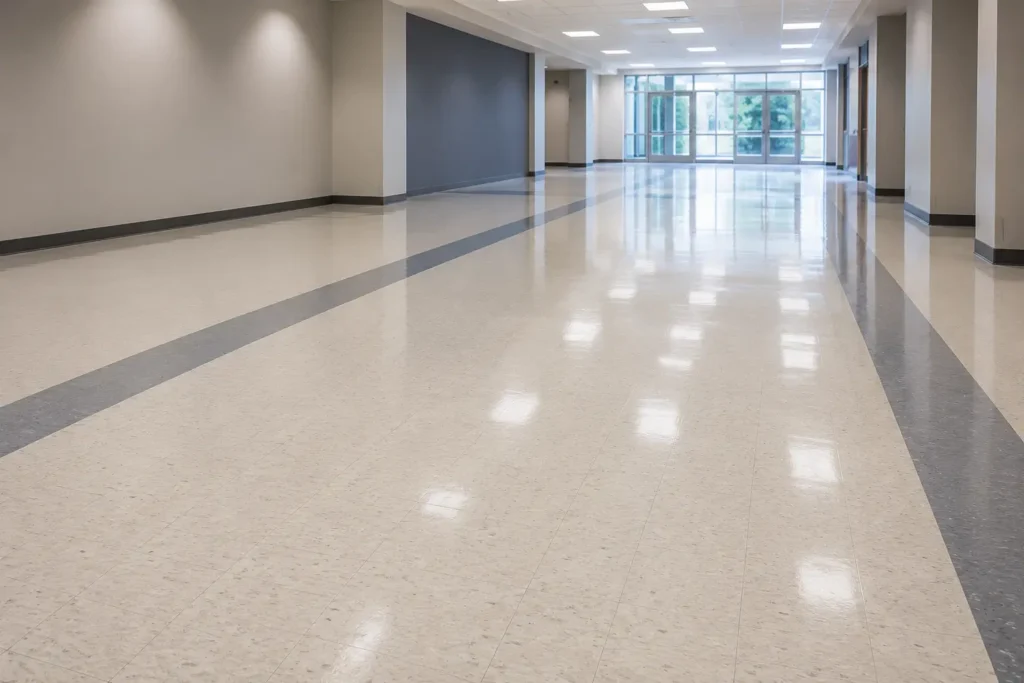
A 1,000-square-foot commercial floor can often be stripped and waxed within one work shift. However, square footage alone does not determine the schedule. The floor condition, layout, existing finish buildup, number of new finish coats, crew size, drying conditions, and access restrictions all affect how long the work takes.
A 4-to-8-hour work window is an illustrative planning allowance for an open VCT floor in reasonable condition, not a measured TCS average or a promised completion time. Confirm the estimate after an assessment and allow separately for the selected finish’s return-to-service requirements.
A heavily worn floor, divided layout, restricted work area, or facility that must remain partially operational may take longer.
Quick answer: Plan for approximately one work shift to strip and wax 1,000 square feet of commercial VCT. The exact timeline should be confirmed after the floor and facility conditions have been assessed.
Need professional VCT floor restoration? TCS Floors provides commercial floor stripping and waxing services for facilities nationwide, including retail stores, schools, healthcare facilities, restaurants, and other high-traffic commercial properties.
Five stages to include in your work window
- 1. PrepareConfirm the floor type, clear movable items and protect access routes.
- 2. StripRemove the old finish, including edges and accumulated buildup.
- 3. Clean & dryRemove residue and let the prepared surface dry before coating.
- 4. Coat & waitApply the specified finish system, allowing each coat to dry.
- 5. ReopenRelease the area for the agreed traffic only after product-specific checks.
Sequence, not a time scale. Drying between coats and readiness for normal traffic are separate milestones.
Plan Backwards From Reopening, Not Square Footage Alone
Before booking a 1,000-square-foot project, tell the contractor what must happen next: staff walking in, deliveries arriving, furniture returning or cleaning restarting. “Crew finished” and “business ready” should be separate entries in the schedule.
- Set the deadline: identify the first unavoidable use of the area and whether another route is available.
- Define the handover: request product-specific instructions for foot traffic, furniture, rolling loads and the first wet clean.
- Allow for uncertainty: ask what happens if old finish needs another removal pass or a coat takes longer to dry.
- Confirm the scope: decide who clears and replaces furniture, secures the area and authorizes reopening.
For project scope and an assessment, see our commercial floor stripping and waxing service. If the existing finish is still sound, discuss a maintenance option before committing to a full strip.
Facilities that need ongoing VCT care can also explore our commercial VCT floor care services, including burnishing, deep scrub and recoat, strip and wax, and scheduled maintenance.
How Long Does It Take to Strip and Wax 1,000 Square Feet?
Stripping and waxing 1,000 square feet generally takes longer than simply dividing the area by a cleaning machine’s production rate. The work includes several stages:
- Preparing and securing the work area
- Removing furniture or movable obstructions
- Applying floor stripper
- Allowing the chemical to dwell
- Scrubbing the old finish
- Detailing edges and corners
- Recovering the stripping solution
- Rinsing and neutralizing the floor
- Allowing the surface to dry
- Applying multiple coats of floor finish
- Allowing each coat to dry
- Inspecting the completed floor
For an experienced commercial floor-care crew working in a clear, open area, the entire process can often be completed overnight or during another planned closure.
The facility should not assume that the floor is ready for unrestricted use immediately after the final coat looks dry. The finish may require additional curing time before it can withstand heavy foot traffic, furniture, rolling loads, or routine cleaning.
Estimated Timeline for a 1,000-Square-Foot Floor
The following is a general planning example, not a guaranteed project schedule.
Site Preparation
The crew first inspects the floor, confirms the flooring material, removes loose debris, blocks access, and protects adjacent surfaces.
Preparation may take longer when the room contains shelving, furniture, displays, equipment, partitions, or other obstacles.
Applying the Stripping Solution
The stripping solution is applied to manageable sections and allowed to remain on the surface for the appropriate dwell time.
The product must stay wet long enough to soften the existing finish. Allowing the stripper to dry on the floor can create residue and make the removal process more difficult.
Scrubbing and Removing the Old Finish
A floor machine or autoscrubber is used to loosen the worn finish. Edges, corners, baseboards, and areas around permanent fixtures may require manual detailing.
The stripping solution and suspended residue are then recovered using suitable commercial equipment.
A floor with excessive buildup or poorly bonded finish layers may require another stripping pass.
Rinsing and Preparing the Bare Floor
Once the old finish has been removed, the floor is rinsed and cleaned to remove remaining chemical residue.
The surface must be clean, neutral, and dry before new finish is applied. Poor rinsing or residual stripper can interfere with adhesion and leave the new finish cloudy, uneven, or weak.
Applying the New Floor Finish
Commercial floor finish is generally applied in several thin, controlled coats. Each coat must dry before the next one is added.
The number of coats depends on the product, floor condition, expected traffic, desired appearance, and maintenance plan. Additional coats increase both application and drying time.
Final Drying and Reopening the Area
After the final coat is applied, the finish needs time to dry and begin curing.
Light foot traffic may be permitted sooner than rolling equipment, furniture replacement, intensive cleaning, or full operational use. The flooring contractor’s instructions should be followed before reopening the area.
What Factors Affect the Project Timeline?
Condition of the Existing Finish
A floor with light, uniform finish buildup is usually easier to strip than one with years of uneven recoating.
The project may take longer when the existing finish is:
- Heavily built up
- Yellowed or discolored
- Peeling or flaking
- Contaminated with grease or chemicals
- Deeply scratched
- Unevenly applied
- Embedded with soil
- Accumulated along edges and baseboards
The condition of the finish often affects the schedule more than the square footage itself.
Floor Layout
A clear, rectangular 1,000-square-foot room is generally faster to service than the same amount of flooring divided among offices, treatment rooms, corridors, restrooms, classrooms, checkout lanes, or storage areas.
Tight spaces require more edging, handwork, equipment repositioning, and detailed cleaning.
Furniture and Equipment
Furniture, displays, shelving, carts, and movable equipment can reduce production speed.
Before scheduling the work, confirm:
- Which items the facility will remove
- Which items the floor-care crew can move
- Whether heavy equipment must remain in place
- Where displaced items can be stored
- When furniture can safely return to the finished floor
Placing heavy furniture on a finish that has not adequately cured can leave marks or damage the coating.
Number of Finish Coats
Every coat requires application and drying time. A high-traffic retail entrance or school corridor may need a different finish system from a lightly used office room.
The goal is not simply to apply the greatest possible number of coats. The finish system should match the flooring material, traffic level, maintenance equipment, cleaning program, and performance requirements.
Temperature, Humidity, and Airflow
Drying conditions influence how quickly each coat can be applied.
High humidity, low temperatures, poor ventilation, or limited airflow may extend drying time. The process should not be rushed by applying a new coat before the previous one is ready.
Crew Size and Equipment
The number of trained technicians and the equipment selected for the project affect production.
A properly organized commercial crew can divide responsibilities among:
- Chemical application
- Machine scrubbing
- Edge detailing
- Solution recovery
- Rinsing
- Finish application
- Site monitoring
Larger equipment may improve production in open spaces but may not be suitable for narrow corridors or rooms with permanent fixtures.
Facility Access
Commercial floor work often takes place around operating schedules. Even a relatively small floor may take longer when:
- The facility must remain partially open
- Work must be completed in separate phases
- Only one section can be closed at a time
- Security escorts are required
- Elevators or loading docks have limited availability
- Noise restrictions apply
- Work is limited to short overnight windows
- Patients, students, customers, or employees must retain access
The total calendar duration may therefore be longer than the actual labor time.
Can 1,000 Square Feet Be Stripped and Waxed Overnight?
In many cases, yes. A 1,000-square-foot VCT area can often be stripped and refinished during an overnight work window when:
- The floor is suitable for stripping and waxing
- The work area is cleared in advance
- The existing finish is not excessively built up
- Water and electrical access are available
- Temperature and humidity support drying
- The crew has uninterrupted access
- The area can remain closed while the finish dries
An overnight schedule should still include enough time for preparation, stripping, rinsing, drying, finish application, and final curing.
Schools, retail stores, offices, medical facilities, and other commercial properties may also schedule work during weekends, holidays, shutdowns, or seasonal breaks.
Does Every 1,000-Square-Foot Floor Need Complete Stripping?
No. Complete stripping is not always the best maintenance option.
If the existing finish remains firmly bonded and the floor has only moderate wear, a scrub-and-recoat service may be sufficient. This process removes surface soil and damaged upper layers before applying additional finish.
Burnishing may also restore appearance when the finish is still intact and only has light scuffs or reduced gloss.
A complete VCT strip and wax service is more likely to be appropriate when the floor has:
- Heavy or uneven finish buildup
- Yellowing or darkened finish
- Deep scratches
- Peeling or flaking
- Embedded contamination
- Bare or exposed VCT
- Poor adhesion between coats
- Traffic lanes that no longer respond to burnishing
- Finish that cannot be corrected through recoating
Inspecting the floor before quoting the project helps prevent unnecessary stripping while ensuring that severely worn finish is properly removed.
What Types of Floors Can Be Stripped and Waxed?
Vinyl composition tile, commonly called VCT, is the surface most frequently associated with commercial stripping and waxing.
VCT is commonly installed in:
- Retail stores
- Schools and universities
- Healthcare facilities
- Office buildings
- Government facilities
- Churches
- Fitness centers
- Restaurants
- Grocery and convenience stores
- Commercial corridors and common areas
Some other resilient floors and sealed surfaces may accept a compatible finish, but they should not be treated automatically as VCT.
Luxury vinyl tile, sheet vinyl, linoleum, rubber, polished concrete, epoxy, ceramic tile, natural stone, and factory-finished flooring may require different maintenance methods.
The flooring material and existing coating should always be identified before a stripping chemical or finish is selected.
How Much Does It Cost to Strip and Wax 1,000 Square Feet?
The cost cannot be determined accurately from square footage alone. Ask for an itemized scope covering preparation, finish removal, the selected finish system, and any after-hours or phased access requirements.
A commercial quote may consider:
- Total serviceable square footage
- Flooring material
- Existing finish condition
- Number of finish layers to remove
- Amount of edge and corner detailing
- Floor layout
- Furniture or equipment movement
- Number and type of new finish coats
- Access to water and electricity
- Required work hours
- Site location and travel
- Security, insurance, or documentation requirements
- Whether the work is one-time or part of a maintenance program
- Whether multiple facilities are included
A 1,000-square-foot open floor in reasonable condition may require less labor per square foot than several small rooms totaling the same area.
For an accurate figure, request a commercial quote based on the floor condition, layout, operational schedule, and required finish system.
How Long Before the Floor Can Be Used?
Drying time and curing time are not the same.
A coat may feel dry enough for another application while the complete finish system is still developing strength. Reopening the floor too early can lead to:
- Footprints
- Scuffing
- Furniture marks
- Embedded dirt
- Wheel or cart tracks
- Reduced gloss
- Premature finish failure
The reopening schedule depends on the finish product, number of coats, temperature, humidity, airflow, traffic type, and manufacturer instructions.
Facility teams should confirm separate times for:
- Applying the next finish coat
- Allowing light foot traffic
- Replacing furniture
- Allowing carts or rolling equipment
- Resuming wet cleaning
- Returning to full operational use
How Often Should Commercial Floors Be Stripped and Waxed?
There is no universal schedule for every facility.
A full strip and wax should be based on the condition of the finish rather than an arbitrary date. Some floors can remain serviceable longer when they receive consistent dust mopping, appropriate cleaning, burnishing, and periodic recoating.
Service frequency may be affected by:
- Daily foot traffic
- Entrance matting
- Weather and tracked-in debris
- Spills and contamination
- Floor-cleaning procedures
- Burnishing frequency
- Appearance standards
- Cart and equipment traffic
- Quality of the existing finish
- Previous maintenance history
A structured commercial floor maintenance program can help preserve the finish and reduce unnecessary full stripping.
How to Prepare for a 1,000-Square-Foot Strip and Wax Project
Facility preparation can help the crew work efficiently and reduce downtime.
Before service begins:
- Confirm the exact flooring material
- Identify all areas included in the project
- Clear movable furniture and loose items
- Provide access to water and electricity
- Schedule deliveries outside the work window
- Notify employees, occupants, or tenants
- Restrict access to the work area
- Confirm security and building-access requirements
- Discuss sensitive equipment and permanent fixtures
- Identify any damaged or loose tiles
- Confirm when the floor must return to service
- Coordinate alarm, elevator, and loading-area access if needed
The contractor should also know whether the facility has special requirements involving low-odor products, infection-control procedures, documentation, inspections, or restricted operating hours.
Commercial Strip and Wax Services for High-Traffic Facilities
TCS Floors provides commercial VCT stripping and waxing for facilities across the United States. Project schedules can be coordinated around store hours, school calendars, patient access, operating shifts, inspections, and other facility requirements.
Commercial capabilities include:
- One-time floor restoration
- Overnight and weekend scheduling
- Multi-location project coordination
- VCT stripping and refinishing
- Scrubbing and recoating
- Burnishing
- High-traffic area maintenance
- Scheduled floor inspections
- Before-and-after documentation
- Recurring floor-care programs
TCS Floors works with retail stores, schools, office buildings, healthcare facilities, government properties, and other high-traffic commercial environments.
Commercial and industrial facilities only. Residential floor waxing is not provided.
Request a Commercial Floor Assessment
The most reliable way to estimate the schedule for 1,000 square feet is to evaluate the actual floor.
TCS Floors can review the flooring material, existing finish, layout, traffic conditions, operational schedule, and desired results before recommending stripping and waxing, scrubbing and recoating, burnishing, or another maintenance option.
Request an instant quote or call 866-607-8659 to discuss your commercial floor-care project.
Frequently Asked Questions
How long does it take to strip and wax 1,000 square feet?
Use a work shift only as an initial planning allowance, not a guaranteed completion time. The actual schedule depends on floor condition, access, the finish system and drying conditions. Confirm a site-specific estimate and separate return-to-service instructions before scheduling normal use.
Can 1,000 square feet be stripped and waxed overnight?
An overnight work window may be suitable, but the contractor must confirm both the work schedule and when the selected finish can accept the traffic expected the next morning.
What can make a 1,000-square-foot project take longer?
Heavy finish buildup, multiple small rooms, detailed edge work, furniture movement, contamination, additional finish coats, high humidity, restricted access, and phased scheduling can extend the project.
How soon can people walk on a newly waxed floor?
The reopening time depends on the finish product, environmental conditions, and number of coats. Light foot traffic may be allowed before furniture, carts, equipment, or wet cleaning. Follow the contractor’s and finish manufacturer’s instructions.
Does every worn VCT floor need complete stripping?
No. A floor with firmly bonded finish may only require burnishing or scrubbing and recoating. Complete stripping is generally reserved for heavily built-up, contaminated, peeling, yellowed, or severely worn finish.
How much does it cost to strip and wax 1,000 square feet?
The cost depends on the floor type, condition, layout, finish buildup, required coats, furniture movement, scheduling, and location. An assessment is needed to provide an accurate commercial quote.
Can TCS Floors service multiple locations?
Yes. TCS Floors coordinates commercial floor-care projects and maintenance programs for eligible facilities and multi-location operations across the United States.